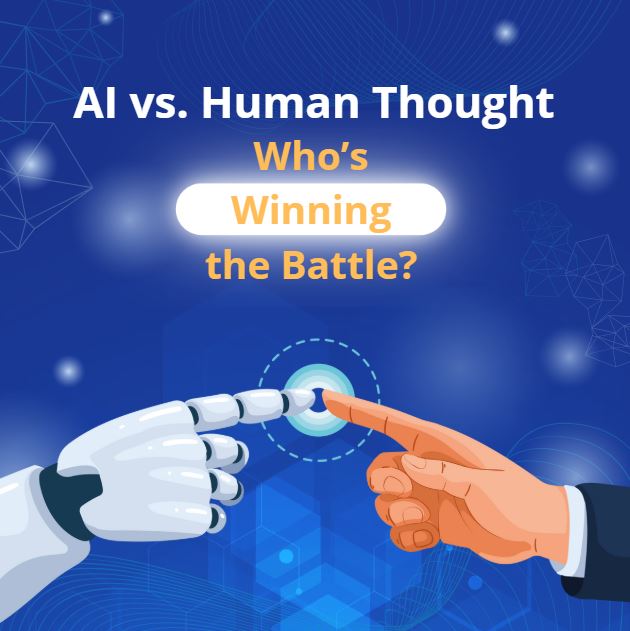
AI vs. Thinking: Who Is Winning the Battle?
October 31, 2025 2025-11-02 8:30AI vs. Thinking: Who Is Winning the Battle?
by: Poorvi Roopesh
We all use AI, and it has become a major part of our lives. From adults in every profession to students in every school, AI is deeply integrated into our daily routines. Globally, an estimated 500 to 600 million people engage with AI every day. To its credit, AI can accomplish an impressive range of tasks. It can automate processes, analyze vast amounts of data to uncover insights, and solve complex problems. These capabilities allow us to tackle challenges more efficiently.
However, with AI’s rise has come a growing dependency. Many people, especially students, now rely on AI for answers and solutions. AI has changed how we think and learn. With the emergence of this powerful tool, we are seeing shifts in other areas of life. From writing aids to platforms like ChatGPT, AI is everywhere. We can now ask algorithms to make decisions and complete tasks for us. But every task, regardless of age or profession, is an opportunity to think critically and make decisions. In the past, when we didn’t know the answer, we would think harder or ask a friend for insight. Today, critical thinking is slowly fading as cognitive offloading becomes more common. Cognitive offloading occurs when people delegate mental tasks to tools. This trend can be especially problematic for students. Our ability to think deeply, beyond just finding answers, is diminishing. We used to ask questions, evaluate scenarios, and analyze situations without even realizing it. But with the convenience of AI, how many people will continue to do this?
Innovations and ideas come from empathizing with a problem, identifying it, and brainstorming solutions. AI, unfortunately, cannot do that yet. But as dependency grows, the number of people engaging in critical thinking may decline substantially.

As Yasmin Odeh (12th) put it, “I think AI dependency definitely exists. Since AI is everywhere, it really can’t be stopped, but it can be moderated, which would help people not be dependent on it. I think that students really do like to rely on it a lot, and so you’re not thinking as much, but I do think that AI does definitely help if you’re using it in the right way, so I think there’s pros and cons to it.”
Relying too heavily on AI carries several risks. These include reduced capacity for critical thinking and independent problem-solving, shortened attention spans, weaker memory retention, and lower creative output. A study of 300 university students found that higher academic stress and performance expectations predicted greater AI dependency. The top reported negative consequences included increased laziness, decreased creativity, and reduced critical and independent thinking. Critics of the AI dependency argument claim that AI does not replace thinking. They argue that it enhances it. AI tools help people process information faster and access complex knowledge. They believe that using AI for data analysis can lead to significant gains in efficiency and accuracy. While these points may be valid, they address the use of AI, not the dependency on it. The overwhelming dependency, is what poses a threat to cognitive development.

Advika Chandras (11th) said, “ I think AI can definitely be used for good. It is not all negative – there are ways to use it effectively to make studying easier and it can be an overall tool, but it is how you use it that matters.”
AI is not a harmful tool that needs to be eliminated. It is a powerful resource that should be used in a balanced and thoughtful way. Cognitive thinking is slowly fading as we become less creative and less critical. We should treat AI as a partner to support and enhance our thinking, not as a shortcut to avoid it.
situs toto bento4d