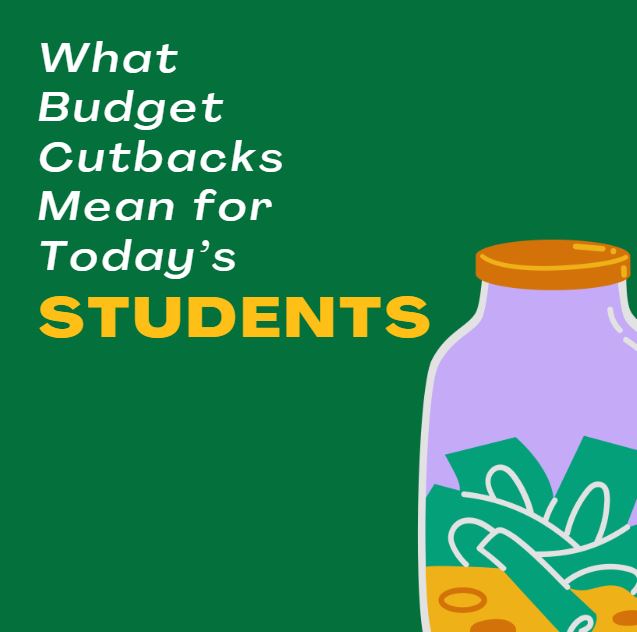
What Budget Cutbacks Mean For Today’s Classrooms
December 18, 2025 2026-01-05 2:40What Budget Cutbacks Mean For Today’s Classrooms
By Anaiya Patel
Education is the process of acquiring knowledge, skills, values, and habits. The purpose of education is multifaceted, aiming to develop individuals holistically by imparting knowledge, fostering critical thinking, and building essential life skills for personal growth, career success, and responsible civic engagement, ultimately empowering people to lead fulfilling lives, innovate, and contribute positively to society and the economy. It prepares people for the future by cultivating adaptability, creativity, and problem-solving abilities while instilling cultural values and promoting social equality.
The question of “What do budgets cutbacks mean for today’s classrooms?” has circulated around schools, throughout classrooms and homes, reaching teachers, parents, students, and even the country as a whole. “How will this affect me?” “Will these changes negatively impact my future?” These questions, a source of concern, have weighed heavily and consumed the minds of parents, teachers, and students alike; leaving more questions than answers.
As we know it, every school will be affected by these budget cuts but that’s not to say that we should lose all hope. I myself began to believe that there was no end in sight until I spoke with Mr. Kent, the principal of IA. Mr. Kent says, “We prioritize the students. The schools goal is to protect the staff closest to the students as they are the ones who teach them what they need to know. We will leverage new technologies. Extracurriculars, arts, and advanced courses will NOT be disturbed. If anything the only aspects that will change would be minimal such as using wood in engineering instead of steel or metal. Not only that but there won’t be a change to classroom size so there will still be relatively the same number of students per class.” Good teachers beat good resources. You could have access to the best resources in the world but without a good teacher, learning is stunted. Mr. Kent says, “Our goal is to keep the money to students as close as possible.”
Mr. Kent is constantly working with business partners and negotiating a dollar-to-dollar match. The way it works is if business partners give x number dollars then they get x amount off on taxes by the IRS. He also has a grant team working towards new grant opportunities.
The truth of the matter is that these budget cuts will hurt schools across the county including IA but surprisingly not to the extent you may think. Even though it feels like the sky is falling it’s not as bad as it may seem. Back in 2008 the district cut 1,000 positions compared to our 150.
Despite the fact that tighter and stricter changes will be enforced there is a benefit to it. As Mr. Kent explains “these changes will give schools the opportunity to improve efficiency and productivity therefore proving useful in the long run.”
It’s more than apparent that change is hard but at the end of the day change is inevitable whether it be good, bad, both, or even neither. We can’t avoid these budget cutbacks, but we can work on navigating through it together. It’s a team effort not just involving the education board, teachers, principals, parents, but students. What matters are the students. They are the ones being most impacted, and they are the ones where their future is at stake.
Mr. Kent also states “We are feeling the pressure of needing to do more with less. On a positive note, these changes are manageable. I like to look at these changes through rose colored glasses. I’d like to think of these changes as a double-edged sword. Although budget is being cutback we still can work to improve, develop, and grow our school to be the best it can be. When looking at classes such as biotech we were able to turn the expected 40 percent reduced budget into 25 percent.”
It’s important to keep in mind that especially during times like these that it’s not the end, it’s not time to give up or lose hope, in fact it’s the exact opposite. It’s the time to initiate, act, and innovate.
According to Mr. Kent, the county will receive 50 million dollars less per year as costs increase, enrollment drops, and young families aren’t moving in anymore. The issue is that schools aren’t able to keep up with the costs as less students means receiving less money from the county. The thing is that these schools can’t just shut down as students may still be attending said school, taking about 3-5 years to fully close. These students then suffer as their education will be negatively impacted by lack of funds, teachers, resources, opportunities, etc.
The county implements something called fair share, which is where rich districts states take allocated money and give it back to poorer districts. This is to help support marginalized groups, however, Mr. Kent says that what is happening right now is that the county unfortunately is forced to take more and give less money overall. This results in schools resulting to dipping into their reserves. Reserves are set aside funds, this means less funds in the future.
“In the U.S., public schools are primarily funded by state and local governments. Local funding comes from property taxes, favoring wealthier areas, while federal funds (about 8%) support programs targeted to student needs, like Title I and special education. States allocate funds using various formulas—some aiming to balance inequities and others relying more on unequal local property taxes.”(According to Learningpolicyinstitue.org)
So the question now is “What are we going to do?” Well the good news is that we have a plan, a plan that has already been set into motion:
Fulton County Schools is facing growing financial pressures that threaten its ability to sustain critical services for students and staff. Rising costs, declining student enrollment, and changing local and state funding conditions are driving a projected budget shortfall.
G.L.I.D.E. (Growth Opportunities, Lean Operations, Investment in Innovation, Diversify Revenue and Enhance Efficiency) is the district’s strategic approach using current data and reasonable projections to identify financial risks so budgetary concerns are proactively addressed before they are urgent. This framework outlines a path for a cumulative fiscal adjustment of approximately $93 to $95 million over the next five years in order to maintain a healthy fund balance.
Mr. Kent says education is a lifelong endeavor. As the saying goes, if you don’t use you lose it. Education is a stepping stool towards success. (According to the 17 sustainable developments goals.edu) “Education liberates the intellect, unlocks the imagination and is fundamental for self-respect. It is the key to prosperity and opens a world of opportunities, making it possible for each of us to contribute to a progressive, healthy society. Learning benefits every human being and should be available to all.” It’s imperative to think of education as an investment rather than a cost.
Works Cited
“G.L.I.D.E. – Fulton County School System.” Fultonschools.org, 2025, www.fultonschools.org/all-departments/financial-services/glide. Accessed 15 Dec. 2025.
Learning Policy Institute. “How Money Matters: Education Funding and Student Outcomes.” Learning Policy Institute, 9 Apr. 2025, learningpolicyinstitute.org/product/how-money-matters-factsheet.
“The 17 Sustainable Development Goals» Penn State College of Nursing.” Www.nursing.psu.edu, www.nursing.psu.edu/sustainability-council/the-17-sustainable-development-goals/.
- Overview of G.L.I.D.E. and Financial Challenges (PDF)
- Overview of Revenue-Generating and Cost-Reduction Strategies (PDF)
- Revenue-Generating and Cost-Reduction Recommendations (PDF)