
The Process of the Pinnacle Project
September 3, 2026 2026-09-10 13:23The Process of the Pinnacle Project
By Anaiya Patel
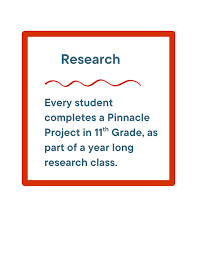
As sophomore year reaches its climax and summer break is right around the corner, students are quietly placed into a research class. Once the three months of summer break are up students are then introduced to the Pinnacle project. The Pinnacle project is essentially a rite of passage every junior will go through because a research class is an IA requirement. The Pinnacle Project is where juniors are given the opportunity to come up with a project idea that they would be interesting in researching for the entire year. From science to art topics, students have both the flexibility and freedom to be able to choose what they want and from what angle they wish to approach it. Students explore, research, and further develop their topics as the year goes by. Mrs. Staiti, a research teacher says, “Students take research courses to learn how to meaningfully ask questions, find trustworthy information, evaluate evidence, fill a gap in their field of study, and draw well-supported conclusions to create a final product to showcase their findings.” The best thing about Research at IA is that it doesn’t even have to be science-related! In fact humanities is a core component of many research topics.
As students enter their junior year, it is not uncommon for some to struggle with choosing their topics and even find trouble narrowing it down as they may have a wide variety of things they’d like to research (which is completely understandable.) Mrs. Staiti adds, “The main steps of the Pinnacle Project are to identify a topic, explore ideas through research based-evidence, collect data and conduct or create a final product for showcase.” A student who may choose one topic early in the year may decide that it’s not for them and completely switch gears, which is what makes Research special. It gives students the room to actually go out into the world and not just be able to learn more about their interests but share it with others. Smith Andres [11th] says, “My topic for the Pinnacle Project is a social media account with water, safety, advice, and lessons to hopefully give people the correct precautions when in an aquatic environment.” Andres goes on to talk about how as both a lifeguard and swimmer, water safety is a frequent encounter for him and that he thinks water safety is important, especially as he is around many inexperienced swimmers who could benefit from safety lessons.
Your research topic and process doesn’t have to be perfect. All that matters is that you choose a topic important to you. It can even be something that may not sound as serious or heavy as topics such as school shootings or mass poverty. Even if nothing stands out to you, it can be something as simple as the fermentation of different cheeses around the world. Mrs. Staiti continues by saying, “The Pinnacle Project is meant to be a passion project where students identify a topic they wish to explore for the school year, study in depth, fill a gap in their field of study, and to create a final product to share with the public.” Math, Science, History, ELA, Psychology, Economics and so much more, are all subjects that may be applied to their topic. The possibilities are endless.
If you aren’t completely sure what exactly you want to do but you have a rough estimate or ballpark idea regardless of how far away it seems and even if it’s broad, I suggest going for it because you can always cultivate, refine, and enhance your topic as the year goes by. Tyce Crafford [11th] says, “My topic is filtering the movement of wifi signals to see people through solid structures and I think it’s important because it’s a very powerful technology in a time of high surveillance and difficulties with staying anonymous.” Crafford continues on by saying that he is still researching on how far the technology has progressed, and what resources are necessary to try and recreate for educational purposes. During the month of August, students’ main goal is just to figure out and brainstorm an idea that resonates with them and reflects their actual interests whereas the logistics of the topic are often worked out down the road receiving guidance from their teachers. Crafford adds, “I want to gain a better ability to collect information and use my understanding to make something useful.” At the end of the day the project you are doing is for yourself not for anyone else. Teachers are there to just help along the way.
The best part of it all is that students may also combine topics together. Andres adds, “The idea for my project I wanted to find a segue between my two main interests. Swimming and video editing don’t normally have a clear connection so I found a project that built that connection. Right now, I’m still in the planning period.” Once students have decided on their topics they begin to settle into the discovery phase of it all. As of right now, students are tasked with finding a total of 15 sources to use for their research and create an annotated bibliography. Mrs. Stati adds, “They will make a Research plan for the year and complete IRB paperwork to get approved for their topic of choice.” It’s of utmost priority to ensure that you choose a topic you are truly passionate about as you will be working on it throughout the year and eventually presenting it for others to see. Mrs. Stati adds, “It can be daunting to choose a topic that can be studied for the entire school year that meets the FINER requirements (Feasible, Interesting, Novel, Ethical and Relevant). Students must have a novel idea that fills a gap in their field of choice, yet still has enough information to study and research for the first semester, so students often get stuck when considering their options.” I know it may seem like a lot at first but this class is meant to fill students with excitement rather than dread. Your experience all depends on what you make out of the class.
togel slot toto slot bakautoto toto togel toto togel situs slot sv388 bandar toto toto slot toto togel toto hk situs slot bakautoto situs toto situs toto sidney lotto