Em Dashes: Is Humanity Slowly Losing Them?
November 12, 2026 2026-11-12 14:05Em Dashes: Is Humanity Slowly Losing Them?
By Srishti Sawant
Take a quick look at your phone keyboard. Sitting right on the primary screen are your standard periods, commas, and hyphens. But if you want an em dash (—), you have to hold down the hyphen key or dig through secondary menus. On a computer, it takes an awkward combination of shortcuts or relying on auto-correct to turn two hyphens into one long line. In a world dominated by rapid texting and short-form media, this physical friction was already making the em dash a rare sight. But lately, a new threat has emerged: generative artificial intelligence.
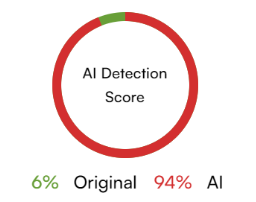
As AI models like ChatGPT have exploded across everyday life, readers and editors have started noticing apparent habits in machine-written text — one of the most obvious being a heavy reliance on the em dash. AI algorithms often default to em dashes because they are trained on professional human writing where dashes are the norm. As Mr. Collins pointed out, “Large Language Models, when scraping trillions of tokens from the internet, also feasted on older textbooks — according to experts — where the em dash predominates.” Now, humans are scrubbing them out of their own writing just to avoid sounding like bots. The Guardian copywriter Sam Woolfe experiences this exact anxiety, noting that writers are being forced to manually strip out em dashes and semicolons to protect their work from false AI accusations. This modern paranoia raises a real question for student writers: is the em dash quietly dying out because we are afraid of sounding like machines?
Considering that the em dash has historically been the ultimate mark of raw, human expression, the fading of its use is quite ironic. In the nineteenth century, poet Emily Dickinson famously filled her handwritten manuscripts with dashes of varying lengths to break up formal meter, capture breath pauses, and convey intimate emotion. Decades later, writers like Virginia Woolf embraced the mark to map the chaotic, non-linear flow of human thought. As author Benjamin Dreyer noted in a New York Times piece on our cultural obsession with the dash, the mark allows writers to drop in extra thoughts without the formal stiffness of parentheses or colons. For Mr. Collins, deciding whether to keep a dash in a draft comes down to human instinct rather than an algorithm.
“It’s more of a feel, really,” Mr. Collins explained. “If it works — to the eye and to the ear — it stays.”
In our own school hallways, students are caught right in the middle of this shift. Senior Eniola Famakinwa [12] notices just how widespread the mark remains in student writing despite the AI stigma.
“I see em dashes pretty often,” Famakinwa observed. “It’s a shame that they’ve been characterized as a sign of AI writing because I use them all the time.”
For students like Famakinwa [12], the sudden suspicion surrounding the mark feels frustrating precisely because it has always been a regular part of their writing.
Senior Advika Chandras [12] also notices dashes naturally sneaking into her drafts whenever she wants to expand on an idea. “I think em dashes are used for a natural flow,” Chandras explained. “Em dashes and colons almost have the same purpose, [at times] but em dashes keep the words in rhythm, in my opinion.” For student writers, using a dash is a deliberate choice to control how a sentence sounds out loud.
Other students view the mark as the best way to capture an authentic, personal voice – something AI tries to mimic but cannot truly feel. Junior Jyothsna Gundala [11] points out that standard punctuation often feels too rigid for personal writing.
“I usually catch myself using em dashes when I’m writing something opinion-heavy or personal, mostly because a set of parentheses feels too clinical and a comma gets lost in the sentence,” Gundala noted. “It feels like adding an inner voice right in the middle of a thought.”
That inner-monologue feel is exactly why human writers shouldn’t surrender the dash to algorithms.
That pursuit of an authentic voice is ultimately what separates human writers from chatbots. When students rely on AI shortcuts instead of doing the work themselves, those borrowed dashes show up like what Mr. Collins jokingly calls “ghoulish groundhogs” across the page. Real writing requires effort, practice, and quiet reflection — otherwise, as Mr. Collins warned, writers risk turning into the dreary frogs from Emily Dickinson’s famous poem “I’m Nobody! Who are you?” — “who all croak the same note, together in the same pond, making the same meaningless sound.” Even professional style guides like The Chicago Manual of Style and The Associated Press Stylebook treat the em dash as a vital tool for shaping sentence rhythm and sudden shifts in thought.
The em dash isn’t an AI invention – it is a centuries-old literary tool designed to give writing human warmth and rhythm. While AI paranoia might make people hesitate before typing the mark, abandoning the em dash out of fear only shrinks our knowledge of punctuation. We aren’t losing the em dash to machines; we just need to reclaim it for our own human voices.
Work Cited
Kramer, Sarah. “The Em Dash: Love It or Hate It?” The New York Times, 14 Aug. 2019, www.nytimes.com/2019/08/14/style/em-dash-punctuation.html.
Woolfe, Sam. “Not Only Am I Losing My Livelihood to AI – I’m Losing Grammar Too.” The Guardian, 1 Oct. 2025, www.theguardian.com/lifeandstyle/2025/oct/01/artificial-intelligence-em-dashes-ai-stealing-my-livelihood.