
Juntos Somos América! – Bad Bunny’s Halftime Touchdown: An Opinion Piece
February 13, 2026 2026-02-20 3:02Juntos Somos América! – Bad Bunny’s Halftime Touchdown: An Opinion Piece
By Annalisa Fletcher & Anaiya Patel
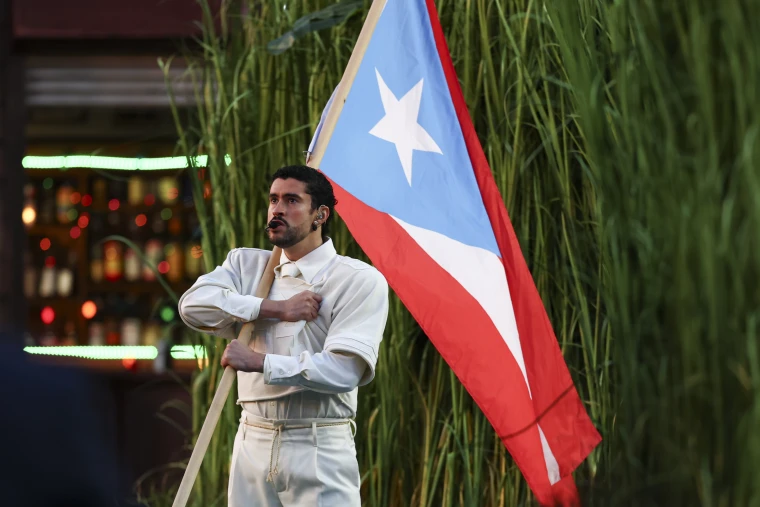
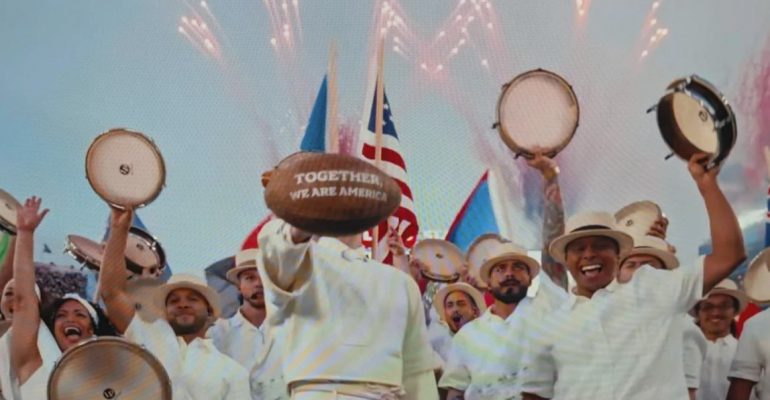
The Super Bowl is the annual championship game of the NFL, marking the culmination of the football season and featuring a high-profile halftime show. On February 8th, 2026, Bad Bunny, a Puerto Rican singer, rapper, and songwriter known as the “King of Latin Trap” and one of the most-streamed artist globally performed the halftime show at the SuperBowl. His performance went far beyond just entertainment and served as a beacon of hope, and cultural pride for his Puerto Rican heritage though his music. Bad bunny is a global superstar, three-time Grammy Award winner, and 17-time Latin Grammy Award winner and he used this historic moment to showcase not only his talent but the power of culture and identity on one of the biggest stages in American history.
Despite much controversy surrounding his initial announcement as the halftime performer, Bad Bunny rose to the occasion and put on a powerful, detailed performance that perfectly encapsulated his Puerto Rican heritage- something he openly takes very seriously and holds close to his heart. Throughout the show he also consistently spread the message of “love over hate” and unity, which felt especially meaningful given the recent global and political tensions. However, this raises the question: why was there controversy to begin with? Bad Bunny is more than a worthy candidate based on both talent and success. He was the number-one most streamed artist on Spotify in 2025, has won numerous Grammys awards, and held the number-one grossing tour in 2022, earning over $230 million. According to the pumaprensa.org it states, “Much public discourse has followed the NFL’s announcement of Bad Bunny as the halftime performer back in September, due to him primarily making music in Spanish.” In addition, some criticized the fact that a “non-American” is performing at one of America’s biggest sporting event, which is a claim that is not only divisive but incorrect. Puerto Rico, Bad Bunny’s home is a U.S territory which therefore makes him an American citizen. This pushback reflects a broader misconception that Spanish is somehow foreign to the United States. In reality, the U.S. is the second-largest Spanish-speaking country in the world, with over 40 million Spanish speakers. Spanish is the second most spoken language in the country, making it deeply embedded in American culture.
Alejandra Márquez, an Assistant Professor of Spanish at Michigan State University, explained in an interview with rcs.msu.edu that, “It’s really important to have an artist who sings only in Spanish at the Super Bowl because in the current political and social climate — where people are often racially profiled or targeted for speaking Spanish — it shows that despite this tension, Spanish-language music and Latinx culture are thriving in the U.S. and around the world.” She further emphasizes that connecting language to culture reveals Spanish not simply as grammar or vocabulary, but as “a living, evolving language that shapes many different cultures and identities.” In this sense, Bad Bunny’s performance was not exclusionary, it was representative. Music transcends language. Audiences do not need to understand every lyric to feel rhythm, emotion, and energy. The global success of K-pop, Afrobeats, and Latin trap proves that feeling often outweighs fluency. Even so, critics claimed that because he would not primarily sing in English, the performance would not resonate. Reports show that Mexico consistently ranks among the top countries for Super Bowl viewership, demonstrating that the NFL audience is already international and multilingual. The divide became so pronounced that some individuals even organized alternative watch events to avoid his halftime show entirely. Yet despite the controversy, early reports suggested that his performance reached approximately 135 million viewers, potentially breaking viewership records. Rather than diminishing his impact, the criticism amplified it. His closing statement, “the world will dance” served as a powerful message that culture connects people beyond politics, beyond borders, and beyond language.
Bad Bunny’s halftime performance was historic not simply because he sang in Spanish, but because of what his presence symbolized. As Sacbee.com states, “Bad Bunny’s performance at the Super Bowl halftime show represents something far more significant than entertainment. It is an act of defiant presence, a cultural assertion that doubles as a political declaration in an era when the two have become inseparable.” His appearance demonstrated that culture and politics are no longer separate conversations. Politics is culture, and culture shapes political identity. The article further argues that “His mere presence on that stage, singing in Spanish to well over 100 million viewers, is itself a political statement.” Without directly addressing specific issues, Bad Bunny’s performance communicated belonging. The symbolism embedded within the performance strengthened this message. Arlene Sosa Almanzar[10] reflected on the
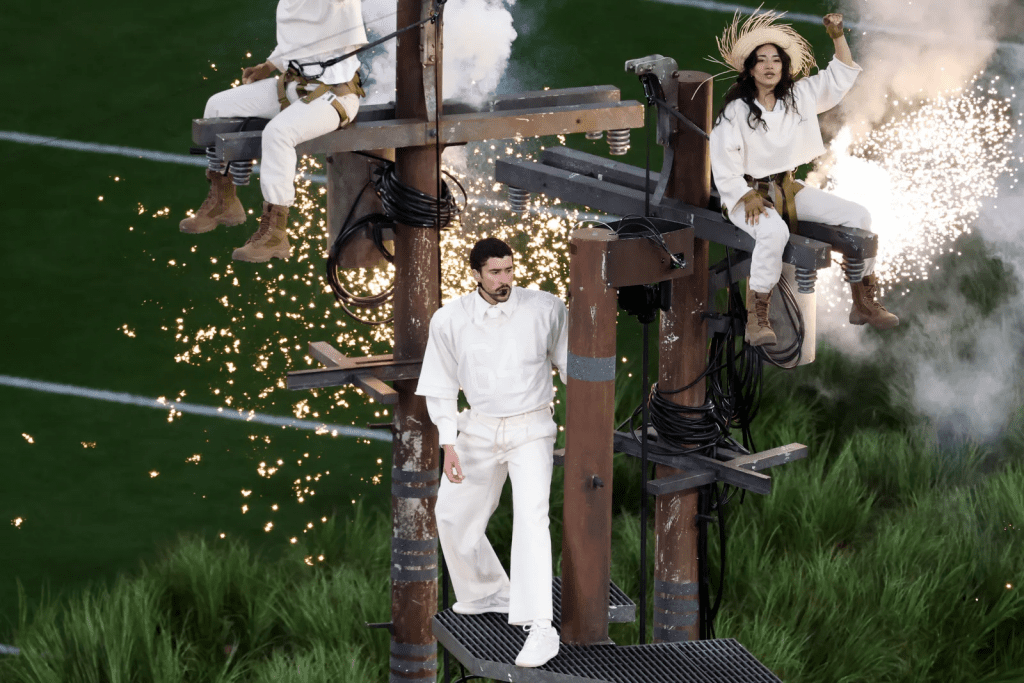
imagery of sugar cane at the beginning of the show, interpreting it as a representation of colonization and the long history of exploitation in Puerto Rico. She says, “In my personal opinion, I think he did a really good job representing colonization with the imagery of sugar cane at beginning and disparities caused by things like power outages which is a big thing in Puerto Rico because of privatization of power companies caused by the occupation of Puerto Rico by the U.S….He represented a lot of niche things for Latinos. Like the party and kids sleeping on the chair.” Yet, rather than centering solely on hardship, the performance emphasized resilience through many scenes of celebration.
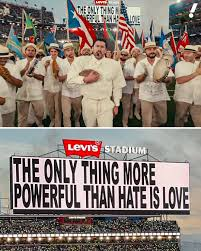
Arlene also observed the representation of diverse skin tones among the dancers, reflecting the diversity present throughout Latin America and the Caribbean. By showcasing this range, Bad Bunny quietly dismissed stereotypes about racial homogeneity within Latino communities. Perhaps most significant was his decision to respond to division with love rather than hostility. He created a performance rooted in joy, unity, and celebration. Combating negativity with love makes it easier for audiences to align themselves with inclusion rather than resentment. The overall theme of unity was evident not only in choreography and visuals but in tone. People of different backgrounds, ethnicities, and languages were shown dancing and laughing together.
Bad Bunny’s Super Bowl halftime performance will be remembered as more than a musical showcase. It marked a cultural turning point in which identity, language, and nationality intersected on one of the largest platforms in American media. By proudly performing in Spanish, highlighting Puerto Rican history, and centering community over conflict, he challenged the idea that American culture is singular or static. Instead, he demonstrated that it is multilingual, multiethnic, and constantly evolving. Through his closing message that “the world will dance,” he emphasized unity in a time of division. Most importantly, he proved that representation is not about exclusion.
Sources Cited:
“Ask the Expert: The Super Bowl Goes Spanish with Bad Bunny’s Halftime Performance.” Department of Romance and Classical Studies, 30 Jan. 2026, rcs.msu.edu/2026/01/30/ask-the-expert-the-super-bowl-goes-spanish-with-bad-bunnys-halftime-performance/. Accessed 9 Feb. 2026.
Madrid, Mike. “Why Bad Bunny Will Divide America by Taking the Super Bowl Halftime Stage | Opinion.” Sacramento Bee, 8 Feb. 2026, www.sacbee.com/opinion/op-ed/article314576220.html. Accessed 9 Feb. 2026.
Why. “The Puma Prensa.” The Puma Prensa, 4 Feb. 2026, www.thepumaprensa.org/blog-2/why-bad-bunnys-super-bowl-halftime-performance-matters. Accessed 9 Feb. 2026.
slot resmi togel resmi slot resmi situs slot slot resmi togel online slot gacor hari ini